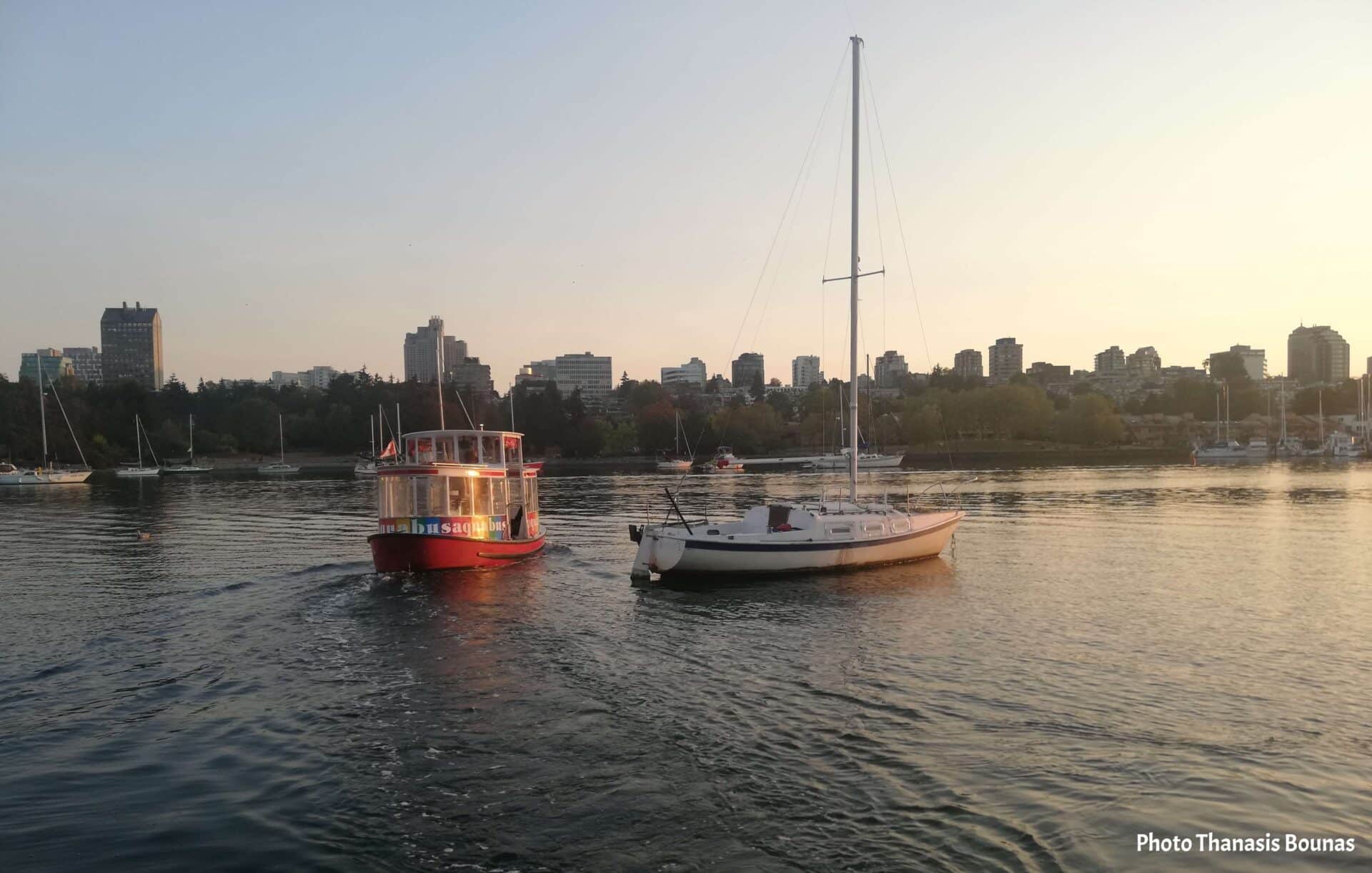
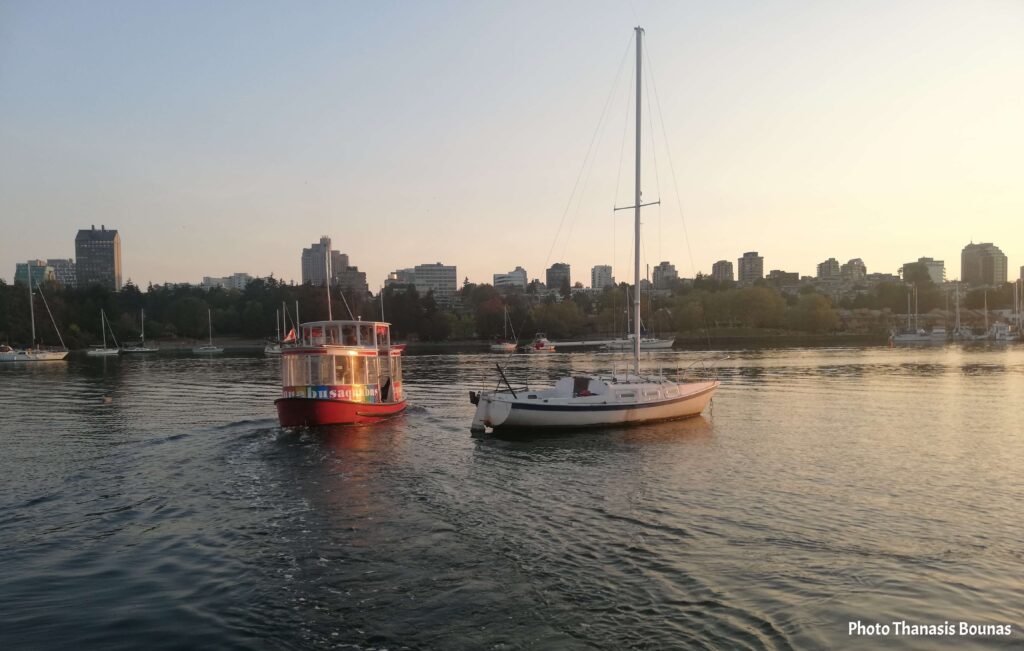
Two boats move across the same water.
One carries people.
The other carries silence.
They do not race.
They do not avoid each other.
They simply share the evening.
The photograph is not about travel.
It is about timing.
In sailing, patience begins with distance.
Between where you are
and where the wind agrees to take you.
Psychologically, this distance is important.
It teaches the mind that movement is not control.
It is negotiation.
The Psychology of Slow Motion
A sailboat never moves alone.
It listens first.
To the water.
To the sky.
To the pressure in the air.
Patience, at sea, is not waiting.
It is attunement.
The mind follows the same rule.
It cannot be pushed forward
without losing balance.
In the psychology of travel, impatience appears
when the body wants arrival
but the world wants process.
Sailing teaches the opposite:
stay inside the interval.
When Direction Becomes Inner Work
The red boat passes.
The white sailboat holds its line.
Two intentions.
One crossing.
Travel looks like geography.
But it is mostly psychology.
Every journey at sea
creates an internal weather.
Expectation.
Fatigue.
Hope.
Silence.
Patience becomes the skill
that keeps these emotions afloat.
Not by fixing them,
but by allowing them to move.
The Sea as a Regulator
Water slows thought.
Horizons soften urgency.
The nervous system responds
before the intellect does.
In sailing, the body learns first.
How to wait.
How to listen.
How to adjust without force.
Psychologically, this is self-regulation.
The mind borrowing rhythm from the sea.
Not everything must happen now.
Not every course must be direct.
Some crossings exist
to change the traveler,
not the location.
Patience as Navigation
A boat does not argue with current.
It reads it.
The mind must do the same.
In the inner voyage of sailing,
patience is not delay.
It is direction.
It is the ability to move
without rushing the meaning of movement.
I return often to this way of seeing
when drifting through
Sailing on bounas.com,
where journeys are not routes,
but negotiations between water, will, and inner time.