The presence of shadow
Shadow in travel is often unnoticed.
We focus on light.
On highlights.
On what stands out.
But every place, like every experience, carries its shadows.
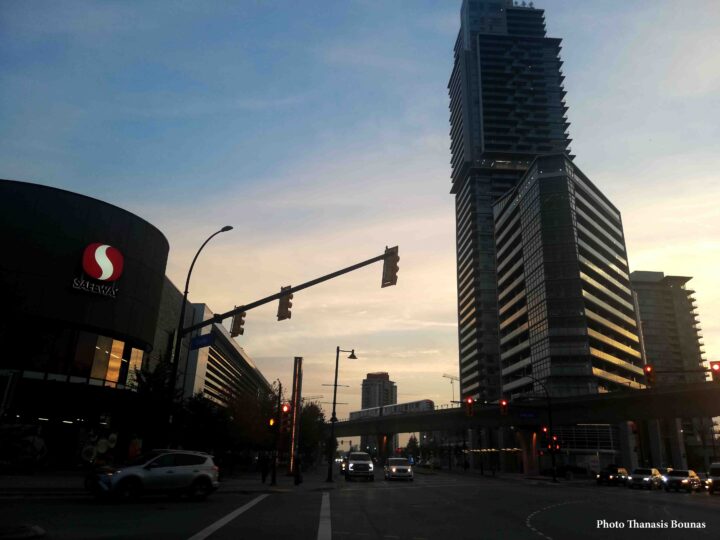
Standing among the glass buildings of downtown Vancouver, you begin to see both at once.
A city built on reflection
Vancouver’s modern architecture is defined by glass.
From the late 20th century onward, the city embraced a style that allows buildings to reflect their surroundings—sky, water, light, and movement. This approach, often called “Vancouverism,” reshaped the skyline into something lighter, more open, more connected to its environment.
But reflection is not only about light.
It reveals shadow too.
Between light and structure
The curves of the building catch the sunlight.
The edges create contrast.
And suddenly, shadow becomes part of the design.
This is where urban space becomes more than functional. It becomes psychological.
Light defines what you see.
Shadow defines how you feel.
The unseen side of movement
Travel is often presented as something bright.
New places.
New experiences.
New perspectives.
But there is always another side.
Moments of uncertainty.
Moments of pause.
Moments that are less visible.
Like shadow, they exist quietly, shaping the experience without demanding attention.
Learning to read the environment
Glass buildings reflect the world, but they also distort it.
They show you what is there, but not exactly as it is.
Sailing works in a similar way. You read the wind, the light, the water—but nothing is ever perfectly clear. You interpret, you adjust, you move.
Understanding comes from awareness, not certainty.
Depth through contrast
Without shadow, there is no depth.
Everything would be flat.
Predictable.
Uniform.
The same is true in travel.
It is the contrast—the unexpected moments, the quieter thoughts—that give meaning to the journey.
Seeing differently
In the end, shadow is not something negative.
It is something necessary.
Standing in downtown Vancouver, surrounded by glass, light, and reflection, you begin to see that every place holds more than one layer.
And sometimes, what is not immediately visible…
is what shapes the experience the most.