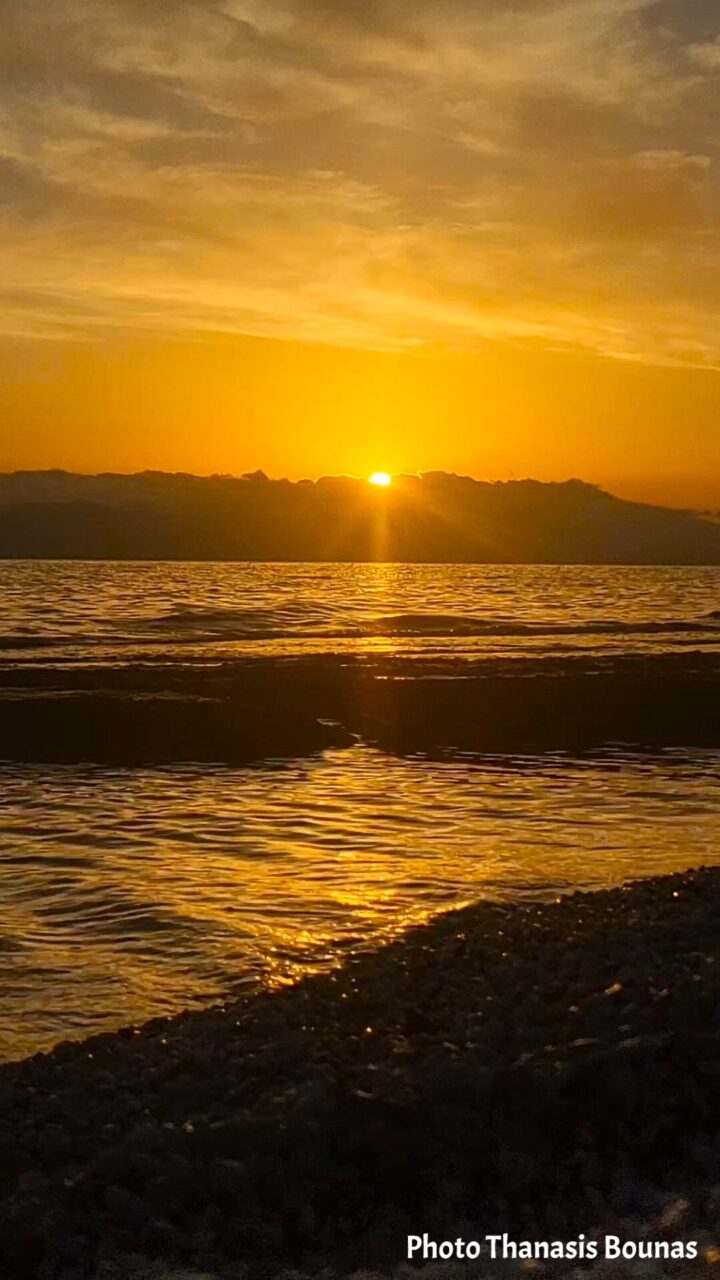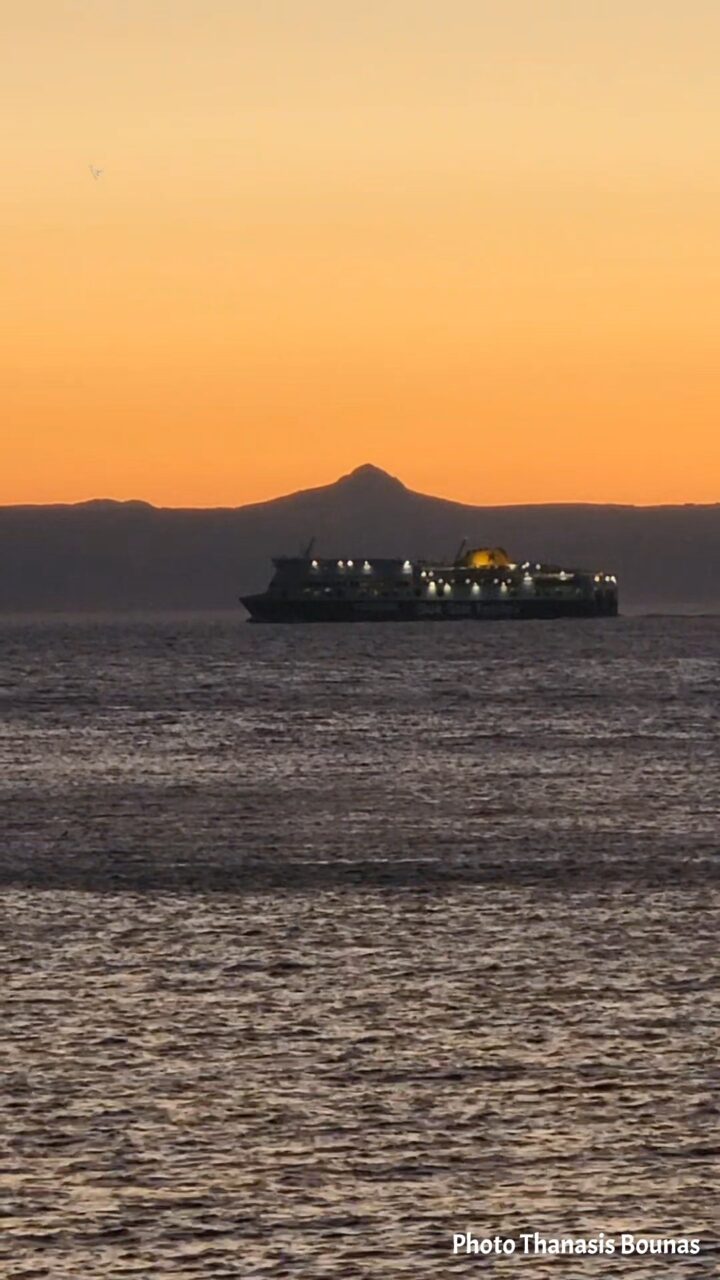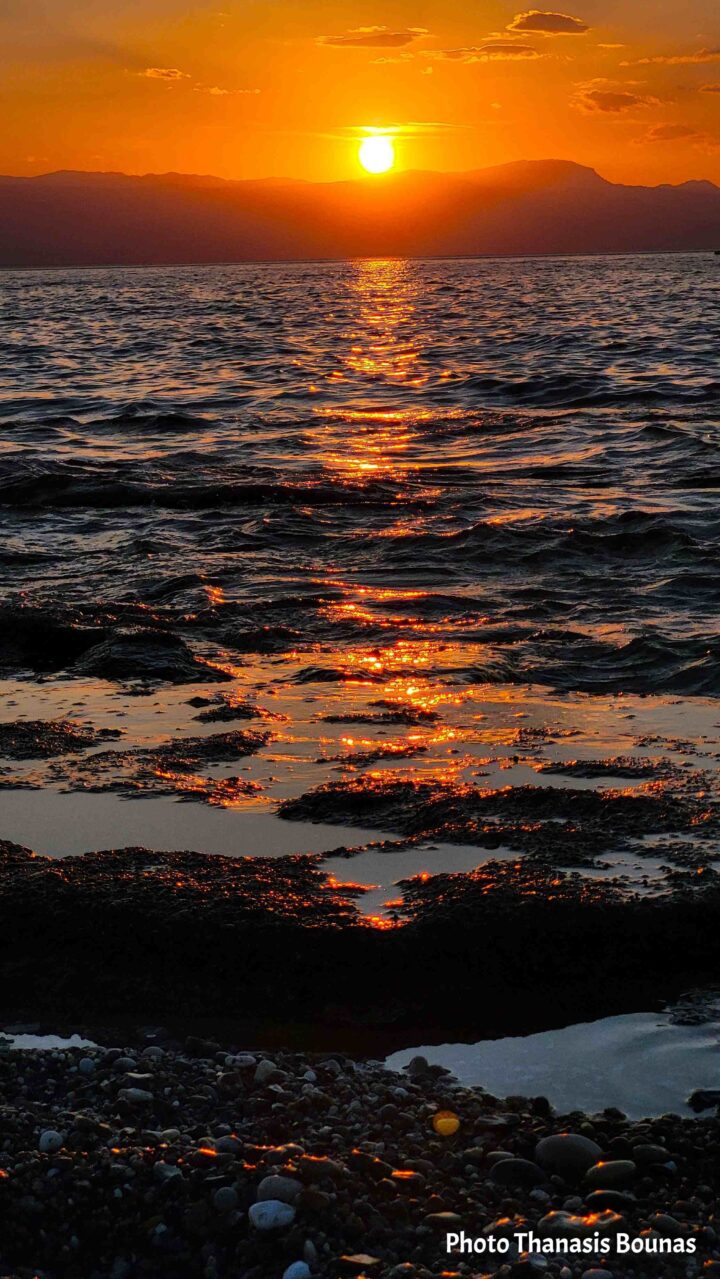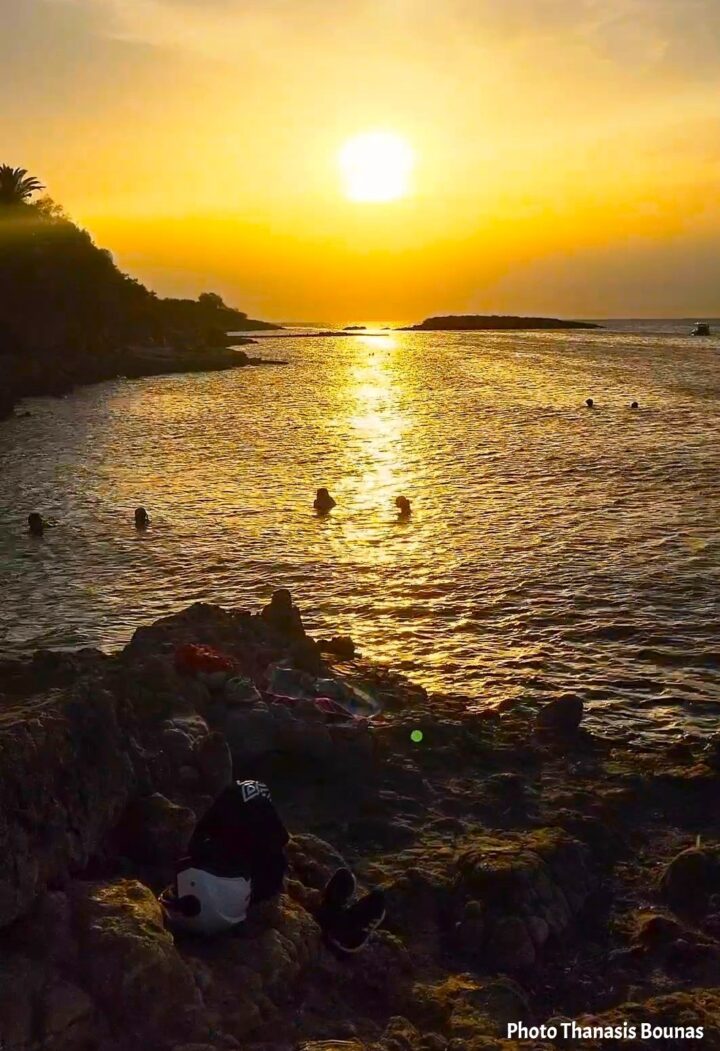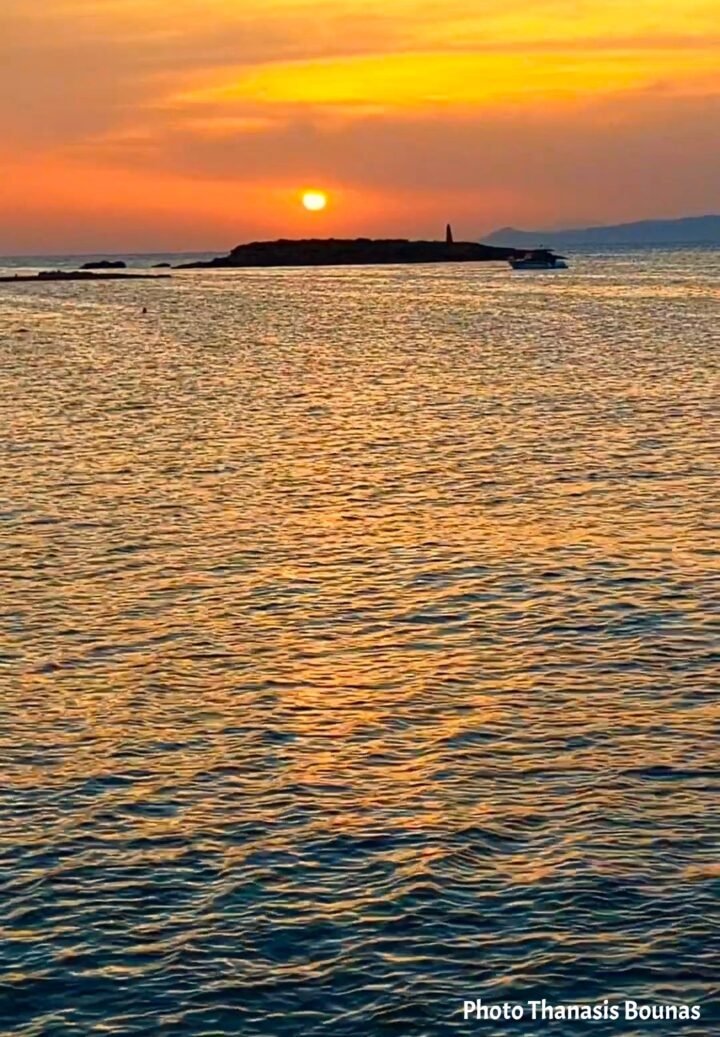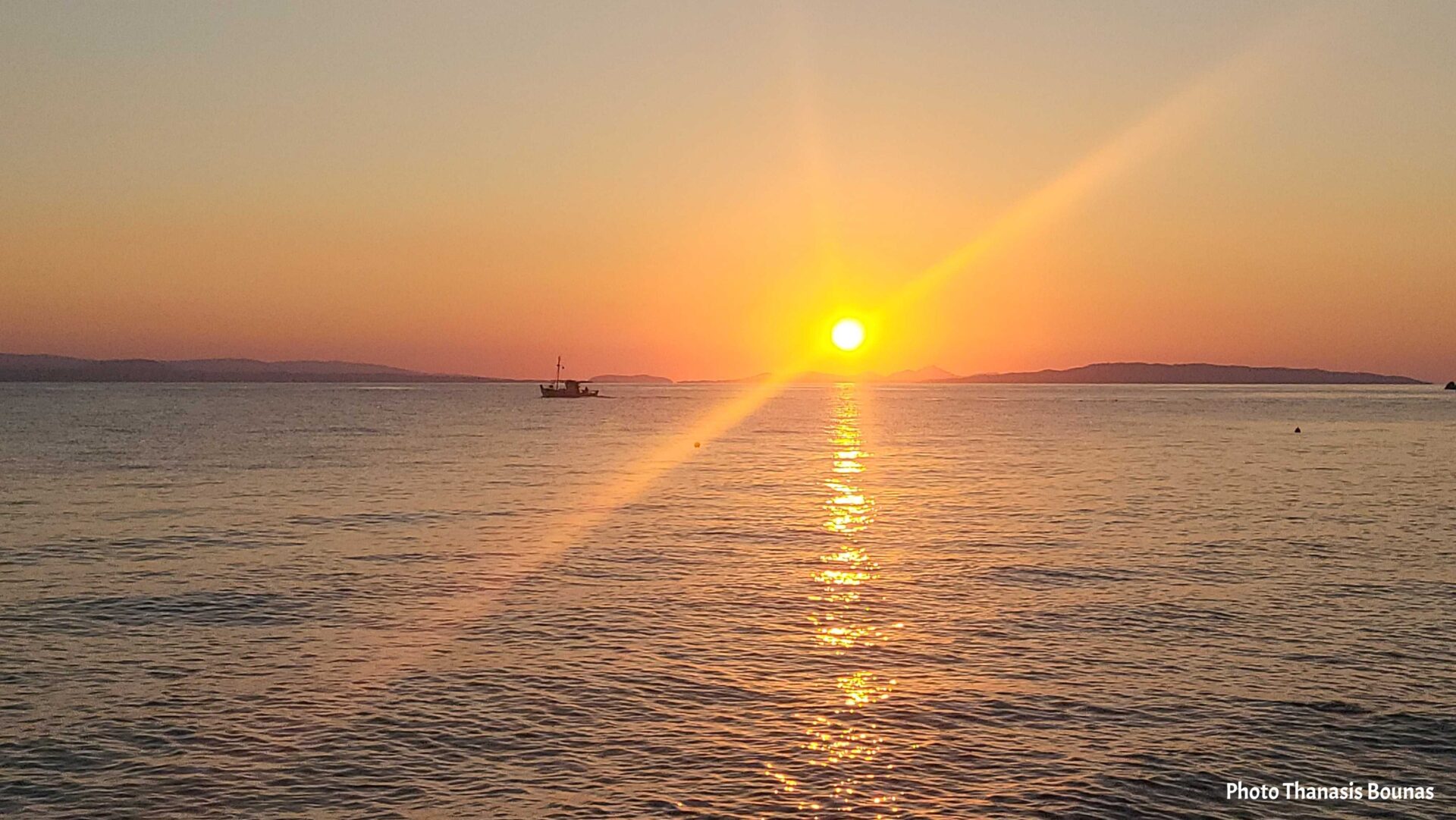
At sunset, Delos can appear almost silent.
The sun falls toward the horizon, the Aegean turns golden, and the low rocky island slowly becomes a dark silhouette against the evening sky.
Today, Delos is known throughout the world as one of the great archaeological sites of Greece.
But more than two thousand years ago, this small island in the Cyclades was anything but quiet.
Pilgrims arrived to worship Apollo and Artemis. Sailors entered its harbors. Merchants, bankers and shipowners came from different parts of the Mediterranean. Ships carried people and goods through waters that are now crossed by visitors travelling between the Greek islands.
For centuries, Delos stood at the intersection of religion, maritime travel and commerce.
The island visible in this sunset was once one of the great meeting places of the ancient Aegean.
Sunset over Delos, Greece.
The Sacred Island of Apollo and Artemis
The importance of Delos began long before it became a great commercial center.
According to Greek mythology, Leto gave birth here to the divine twins Apollo and Artemis.
This association transformed the small island into one of the sacred places of the ancient Greek world.
Human presence on Delos reaches back to the third millennium BC, while the sanctuary of Apollo was established at least by the 9th century BC. During the Archaic and Classical periods it developed into a major Pan-Hellenic sanctuary, attracting worshippers from across the Greek world.
The importance of Delos was therefore far greater than its physical size might suggest.
People did not need to live on the island to consider it important.
They travelled there.
And because almost everyone approaching an island in antiquity arrived by sea, the history of sacred Delos is inseparable from the history of ancient sailing.
The harbors were the entrances to the sacred island.
Every pilgrim approaching Apollo’s sanctuary first had to cross the Aegean.
When Delos Became a Center of the Greek World
Religion was not the island’s only connection with wider Greek history.
After the Persian Wars, Athens and numerous allied Greek states formed what became known as the Delian League in 478/477 BC.
The choice of Delos was highly symbolic.
The island’s Pan-Hellenic religious status made it an appropriate meeting place, and the league’s treasury was initially kept there before Athens later transferred it to the Acropolis.
For a small Cycladic island, this represented extraordinary political importance.
Delos was not a military superpower.
It did not possess a vast territory.
Its influence came from something different: its sacred status and its position within the maritime world of the Aegean.
That relationship with the sea would eventually transform the island once again.
From Sacred Island to Cosmopolitan Port
A dramatic change came after 167 BC, when Delos was declared a free port.
Its commercial importance expanded enormously.
Merchants, bankers and shipowners from many parts of the Mediterranean settled on the island. Warehouses and commercial establishments appeared alongside residential districts, while wealthy inhabitants constructed elaborate houses decorated with mosaics and frescoes.
The archaeological remains reveal just how international Delos became.
Alongside the traditional Greek sanctuaries appeared places associated with foreign religions, including sanctuaries dedicated to Egyptian and Syrian gods. UNESCO describes the ancient settlement as an exceptionally important cosmopolitan Mediterranean port whose prosperity reached remarkable levels during the second and first centuries BC.
The Greek Ministry of Culture gives an extraordinary indication of the scale involved: it estimates that around the beginning of the 1st century BC approximately 30,000 people may have been living on this tiny island, with enormous quantities of merchandise passing through its ports.
That completely changes the way we should imagine Delos.
Look at the quiet island today and remove the silence.
Imagine ships entering and leaving.
Sailors handling cargo.
Merchants negotiating business.
Pilgrims approaching the sanctuary.
Languages from different parts of the Mediterranean being spoken along the waterfront.
For a period of its history, Delos was not simply an island.
It was a crossroads.
Sailing Past Delos Today
Seeing Delos from the sea provides a particularly interesting perspective.
The modern sailing boat is obviously separated from the vessels of antiquity by more than two thousand years of technology.
But the geography remains.
The same island rises from the central Aegean.
The same Cycladic landscape surrounds it.
And sailors still see Delos first as ancient mariners did — from the water.
That makes approaching or passing Delos under sail different from simply looking at its ruins on a map.
The sea restores part of the geographical context that archaeology alone cannot provide.
Mykonos lies nearby. Tinos, Syros, Paros and Naxos form part of the wider Cycladic world around it.
From the deck of a boat, it becomes easier to understand how interconnected these islands have always been.
The Aegean did not simply separate them.
For sailors, it connected them.
The Fall of a Great Mediterranean Port
The prosperity of Delos did not last forever.
Its close economic relationship with Rome also made it vulnerable during the conflicts that shook the eastern Mediterranean.
In 88 BC, forces associated with Mithridates VI of Pontus attacked and looted the island.
Another destructive attack followed in 69 BC, carried out by pirates associated with Athenodorus.
Delos never recovered its former importance. Its population declined and the great commercial era of the island came to an end.
Centuries passed.
Buildings collapsed.
The harbors that once received commercial traffic became quiet.
Eventually archaeology began uncovering the lost city. Systematic excavations started in 1872 and have revealed the Sanctuary of Apollo and substantial sections of the Hellenistic settlement.
In 1990, Delos was inscribed on the UNESCO World Heritage List.
And so the island entered another chapter of its long history.
Not as a great commercial port this time, but as one of the world’s remarkable surviving landscapes of ancient Greece.
Sunset Over Delos
This is why a simple sunset over Delos can tell a much larger story.
The video lasts only a few moments.
There are no ancient merchants to be seen.
No pilgrims approaching Apollo’s sanctuary.
No warehouses filled with goods arriving from distant ports.
Only the island, the Aegean and the setting sun.
But approximately two thousand years ago, countless sailors would have looked toward this same island from the decks of their vessels.
Some came to worship.
Others came to trade.
Others were simply passing through one of the busiest maritime landscapes of their time.
Today, sailing through the Cyclades offers a very different journey.
Yet when Delos appears on the horizon, the geography suddenly connects those two worlds.
The boats have changed.
The ports have changed.
The people have disappeared.
But the island and the Aegean remain.
Video & Editing by Thanasis Bounas
Discover more stories from Greece, the Greek islands and the Aegean Sea at Bounas.com